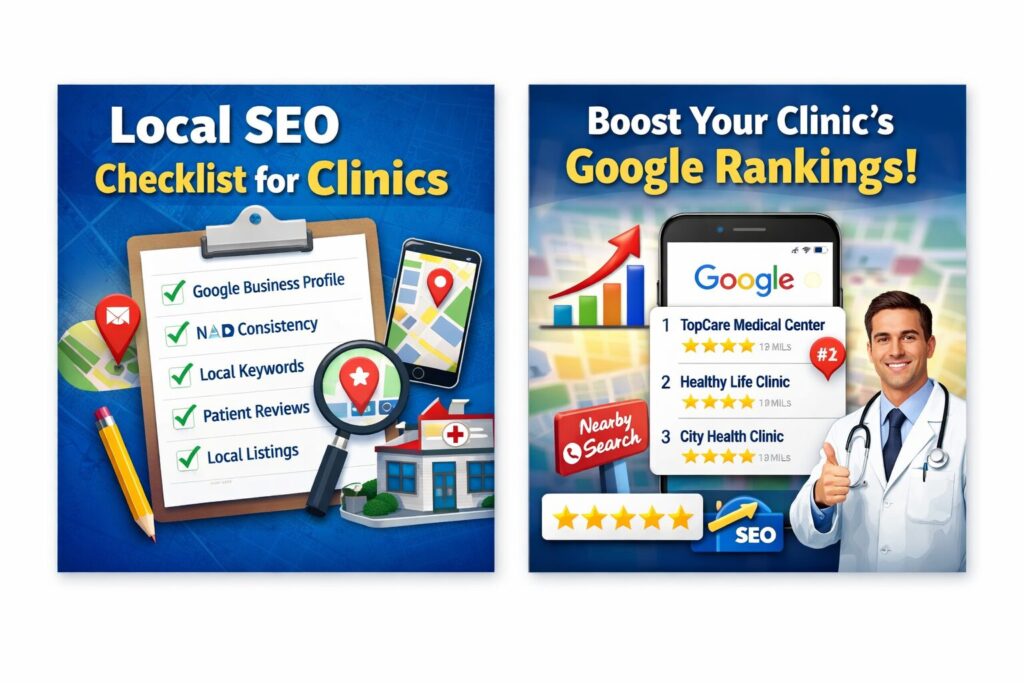
When patients need a doctor, clinic, or diagnostic center, they don’t search randomly. They type things like “dentist near me”, “orthopedic clinic in [area]”, or “best dermatologist nearby.”
If your clinic doesn’t show up in those local search results, you’re losing patients every single day — often to competitors who may not even offer better care.
This is where Local SEO becomes critical.
Local SEO helps your clinic appear in Google Search and Google Maps when nearby patients are actively looking for healthcare services. Below is a complete, practical Local SEO checklist for clinics — written to help you take action, not just understand theory.
1. Optimize Your Google Business Profile (Non-Negotiable)
Your Google Business Profile (formerly Google My Business) is the most important asset for local visibility.
Make sure you:
Use the exact clinic name (no extra keywords)
Select the correct primary category (e.g., Dental Clinic, Orthopedic Clinic)
Add relevant secondary categories
Fill in clinic hours, phone number, website, and services
Write a clear, patient-friendly business description
Upload real clinic photos, doctor images, and interiors
Clinics with complete and regularly updated profiles rank higher and earn more trust.
👉 If your main goal is Google Maps visibility, you should also read Local SEO for Doctors: How to Rank Your Clinic on Google Maps in 2026, where we break down advanced map-ranking strategies in detail.
2. Ensure NAP Consistency Everywhere Online
NAP stands for Name, Address, and Phone Number.
Your clinic’s NAP details must be:
Identical on your website
The same on Google Business Profile
Consistent across directories, hospital listings, and social media
Even small differences (like “Road” vs “Rd”) can confuse search engines and reduce rankings.
Checklist tip:
Create one master NAP format and use it everywhere — no variations.
3. Build Local Landing Pages (Not Just One Website Page)
If your clinic serves multiple areas or cities, one generic “Contact Us” page is not enough.
Create location-specific pages like:
/dentist-in-whitefield/orthopedic-clinic-in-andheri/diagnostic-center-in-gachibowli
Each page should include:
Area-specific content
Services offered at that location
Embedded Google Map
Local patient testimonials
Clear appointment CTA
These pages help Google connect your clinic with local search intent.
4. Collect and Manage Patient Reviews Strategically
Reviews are one of the strongest local ranking factors — and a major trust signal for patients.
Best practices:
Ask satisfied patients for reviews politely
Share the Google review link via WhatsApp or SMS
Respond to every review (positive and negative)
Never buy fake reviews (Google penalizes this)
A clinic with 100 genuine reviews will almost always outperform one with 10, even if services are similar.
5. Optimize Your Website for Local Keywords
Local SEO doesn’t work without proper on-site optimization.
Focus on keywords like:
“Dermatologist in [area]”
“Best pediatric clinic near me”
“Physiotherapy clinic in [city]”
Key places to include local keywords:
Page titles and meta descriptions
Headings (H1, H2)
Service descriptions
Footer location mentions
Avoid keyword stuffing — write naturally for patients first.
6. Add Schema Markup for Clinics
Schema markup helps search engines understand your clinic details clearly.
Use Local Business Schema to highlight:
Clinic name
Address
Phone number
Operating hours
Doctor information
While patients don’t see schema directly, Google uses it to improve local visibility and rich results.
7. List Your Clinic on Trusted Local Directories
Citations still matter in healthcare Local SEO.
Submit accurate listings on:
Healthcare directories
Local business directories
City-based listings
Hospital partner websites
The goal is quality over quantity — avoid spammy directories.
8. Create Local, Educational Content Regularly
Google rewards clinics that educate, not just advertise.
Good content ideas:
“Common Causes of Knee Pain in Adults in [City]”
“Seasonal Allergies in [Location]: When to See a Doctor”
“Dental Care Tips for Patients in [Area]”
This builds authority and helps your clinic rank for long-tail local searches.
9. Optimize for Mobile & Page Speed
Most local searches happen on mobile.
Make sure:
Your website loads fast
Appointment buttons are easy to click
Phone numbers are tap-to-call
Maps and directions work smoothly
A slow or confusing site costs you both rankings and patients.
10. Track Performance & Improve Monthly
Local SEO is not a one-time task.
Track:
Google Business Profile insights
Calls and direction requests
Keyword rankings
Review growth
Small monthly improvements compound into strong, long-term visibility.
Final Thoughts
Local SEO is no longer optional for clinics that want consistent patient growth. When done right, it helps your clinic appear exactly where patients are searching — on Google Search and Google Maps — at the moment they need care.
By following this local SEO checklist, you’re not just improving rankings. You’re building long-term visibility, trust, and accessibility for nearby patients who are actively looking for reliable healthcare services.
However, Local SEO is only one part of competing in today’s healthcare market. Smaller and mid-sized clinics often feel pressured by large hospital chains and corporate clinics with bigger budgets. The good news is that smart digital strategies can level the playing field.
If you want to understand how independent clinics can stand out and grow despite strong competition, read our detailed guide:
10 Marketing Secrets to Compete with Big Clinics.
When Local SEO is combined with the right branding, content, and patient trust strategies, clinics don’t just survive — they grow sustainably.